
How Gamification and Game Development Are Transforming Modern Healthcare
How Gamification and Game Development Are Transforming Modern Healthcare
In today’s digital age, healthcare is undergoing a transformation driven not just by science but also by technology. One unexpected yet powerful contributor to this change? Gamification. Yes, video game mechanics and design strategies are now being used to improve patient care, mental health, physical fitness, and even medical training.
Why Gamification Matters in Healthcare
To begin with, game development isn’t just about entertainment anymore. It’s about creating engaging, interactive experiences that solve real world problems. In healthcare, that means improving outcomes, motivating behavior change, and making health education more accessible.
For example, health focused games can help patients manage chronic conditions like diabetes or asthma. Through gamified systems, they receive real time feedback, rewards, and encouragement, all of which promote consistent engagement.
Why Healthcare Games Work
The medical industry has long used games to train professionals and educate students. Over the past decade, with the advancement of mobile technology and extended reality, healthcare games have become an integral part of our daily lives.
Building on our previous discussion about how Gamification is Influencing Education, it’s clear that similar principles are now transforming healthcare. By using interactive and engaging game based tools, the medical field is enhancing learning, patient engagement, and everyday wellness in powerful new ways.
According to the National Library of Medicine
- Psychological therapy saw positive results in 69% of measured outcomes.
- Physical therapy outcomes improved in 59% of cases.
- Physical activity increased significantly in 50% of interventions.
- Clinician skills were enhanced in 46% of assessments.
- Health education impacts were positive in 42% of studies.
- Pain distraction effects were strong in 42% of cases.
- Disease self‑management improved in 37% of the outcomes measured
From Patients to Professionals: Real World Applications
1. Gamification for Patient Engagement
Patient adherence to medication and lifestyle changes is one of the biggest challenges in healthcare. Fortunately, gamified health apps are changing that. By turning routine tasks into game like experiences, users are more likely to stay consistent. Apps like MySugr and SuperBetter use points, streaks, and daily challenges to encourage users to take control of their health.
2. Mental Health & Cognitive Training
Game based solutions are transforming mental health. Games for anxiety, depression, ADHD, and PTSD now use CBT and mindfulness techniques. For example, EndeavorRx, an FDA approved game, helps kids with ADHD improve focus. It’s a clear sign that therapy and gaming are coming together in powerful ways.
3. Physical Therapy Made Fun
Rehabilitation can be slow and discouraging, but when it’s paired with interactive game mechanics, it becomes motivating. Tools like Reflexion, Wii Fit, and VR-powered rehab systems encourage patients to move more, push their limits, and look forward to sessions.
4. Medical Training and Simulation
Healthcare professionals are also gaining from game based technologies. Realistic training simulations allow students and surgeons to safely practice complex procedures, improving their decision making, speed, and precision, all of which translate to stronger performance in real life situations.
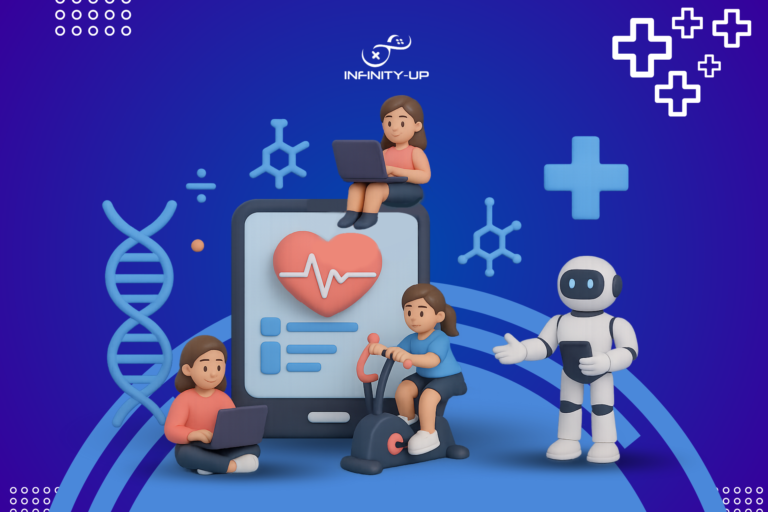
Transforming Care into Play: INFINITY-UP Gamified Solutions
With technology as our canvas and creativity as our spark, we bring digital magic to life.
From games to XR, our end-to-end Services in development, animation, and gamification are designed to turn your vision into next level experiences.
INFINITY-UP leverages powerful technologies to build health focused games that engage and inspire:
Unity and Unreal Engine:
Provide engaging 3D experiences.
HTML5 and WebGL:
Make browser based health games accessible to anyone, anywhere.
AI and Machine Learning:
Personalize challenges and responses for each user.
Wearable Integration:
Allows games to track real time health data like heart rate, sleep, and steps.
Combined, these technologies create meaningful health experiences that feel less like medical tools and more like something people want to use.
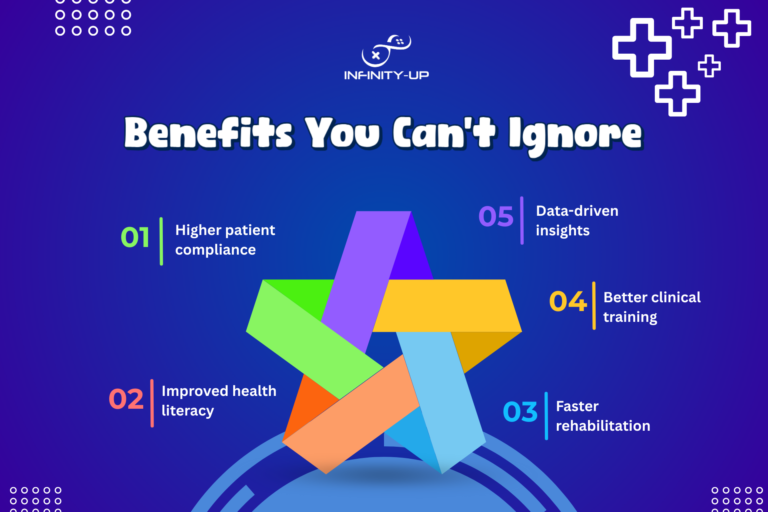
Benefits You Can’t Ignore
Incorporating game development into healthcare brings a variety of long term benefits:
- Higher patient compliance
- Improved health literacy
- Faster rehabilitation
- Better clinical training
- Data driven insights
Conclusion
Game development is no longer confined to entertainment. It’s making health more personal, engaging, and effective. As developers and healthcare providers continue to collaborate, the innovation potential is limitless.
Whether it’s a mobile app for stress relief or a VR platform for physical therapy, games are proving to be powerful tools in the healthcare toolkit.
So, the next time you think of games, think beyond fun. Think of them as instruments of health, healing, and hope.
Unlock Your Vision and request a Free Quote with INFINITY-UP.
FAQ
Q1: Is gamification just for kids, or does it work for adults too?
Answer: While games are often associated with children, the principles of gamification are highly effective across all age groups. Adults are just as susceptible to the psychological drivers that make games engaging, such as the desire for mastery, social connection, and achievement.
Q2: What are examples of gamification in healthcare?
Answer: Examples include fitness apps that reward daily steps, rehab games that track therapy progress, mental health apps using challenges for mindfulness, and interactive education platforms for patients or medical students.
Q3: Are gamified health tools safe and effective?
Answer: When designed with medical input and evidence based methods, gamified health tools can complement traditional care, helping patients stay consistent and improving results while keeping safety in focus.
Q4: Are there any challenges or risks associated with gamification in healthcare?
Answer: Yes. Risks include poor design that frustrates users, a lack of personalization, and data privacy concerns. Maintaining engagement, ensuring ethical mechanics, and integrating with healthcare systems can also be challenging.