

Mobile game monetization is how developers turn player engagement into sustainable revenue through in-app purchases, advertising, subscriptions, battle passes, and other strategies. In 2026, successful games are moving beyond a single revenue model and focusing on flexible, player-friendly approaches that balance spending with retention. Understanding current mobile game monetization trends can help developers choose the right revenue mix while protecting the long-term player experience.
What is mobile game monetization?
Mobile game monetization is the process developers and publishers use to generate revenue from mobile games. It converts player engagement into income through methods such as in-app purchases, advertising, subscriptions, premium content, battle passes, or combinations of multiple revenue models.
What Are the Top Mobile Game Monetization Trends in 2026?
Hybrid Monetization Is the Default
Mobile games no longer have to choose between ads and in-app purchases. Hybrid monetization brings together IAPs, rewarded ads, subscriptions, and other revenue streams, giving players different ways to spend based on how they play and what they value.
LiveOps Is the Revenue Engine
A mobile game can’t rely on its launch-day content forever. LiveOps keeps the experience fresh with seasonal events, new challenges, limited-time rewards, and special offers. These updates bring players back regularly while creating natural moments for engagement and spending.
AI-Driven Personalization
AI is making mobile game monetization feel less one-size-fits-all. By analyzing gameplay, progression, purchase history, and engagement patterns, developers can present more relevant offers, rewards, and promotions. The result is a more personalized experience that can benefit both players and publishers.
Rewarded Video Is a UX Feature
Rewarded video works best when it feels like a choice, not an interruption. As part of mobile game development services, developers can integrate short ads that offer extra lives, currency, energy, or useful boosts, making advertising a natural part of gameplay.
Retention-First, Trust-Based Monetization
The smartest monetization strategies focus on keeping players happy before maximizing short-term revenue. Fair pricing, clear value, reasonable ads, and rewarding progression help build trust. When players enjoy the game and feel respected, they are more likely to stay, engage, and spend.
Direct-to-Consumer Web Shops
Direct-to-consumer web shops are giving mobile game publishers another way to reach paying players. Developers can offer exclusive bundles, bonus currency, loyalty rewards, and limited-time promotions through web-based stores, creating additional revenue opportunities while building a more direct relationship with their player community.
Top 7 mobile game monetization models in 2026
In-App Purchases
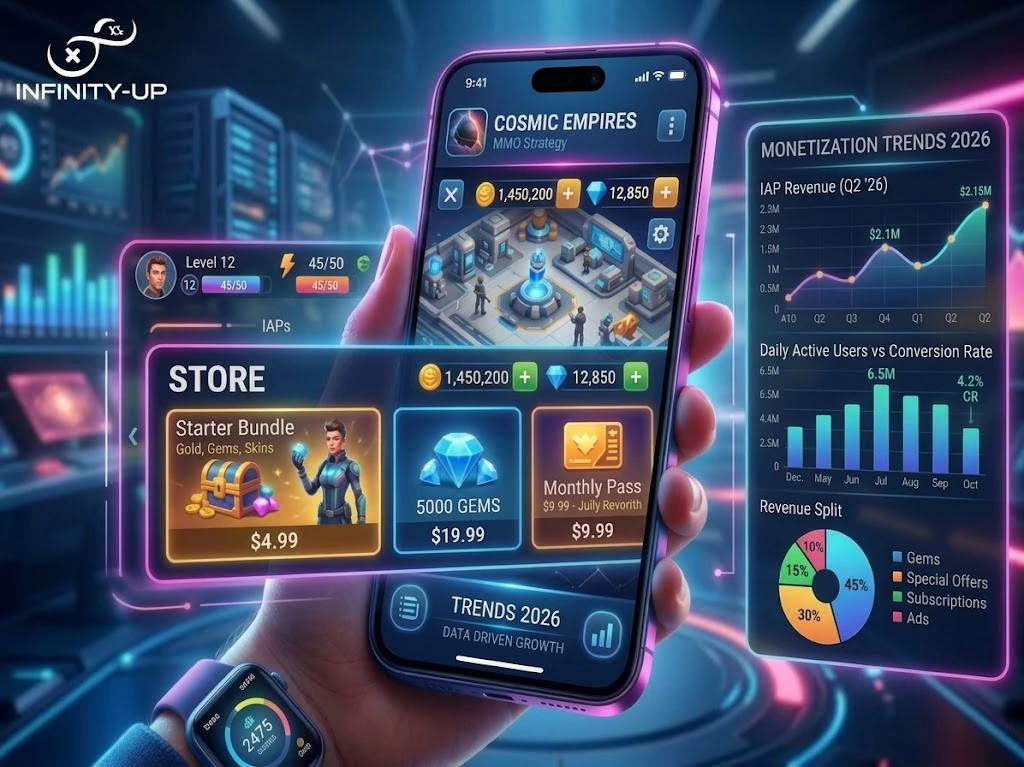
In-app purchases (IAP) allow players to buy digital items or features directly within a mobile game. Common examples include virtual currency, character cosmetics, power-ups, extra lives, progression boosts, premium resources, and downloadable content.
IAP works particularly well for games with strong progression, collection, customization, or competitive systems. Developers can also offer different price points so occasional spenders and high-value players have suitable options.
Common IAP types include:
- Consumable items such as coins, gems, or energy
- Non-consumable purchases such as permanent features
- Cosmetic items and character customization
- Starter packs for new players
- Limited-time bundles
- Progression and convenience items
- Seasonal or event-specific content
A well-designed IAP economy should make prices and benefits easy to understand while avoiding excessive pay-to-win pressure.
Subscriptions & Auto-Renewable Plans
Subscriptions generate recurring revenue by giving players ongoing benefits for a weekly, monthly, or annual payment. Auto-renewable plans can work particularly well when a game consistently delivers fresh content, exclusive rewards, convenience features, or premium experiences.
A mobile game subscription might include:
- Monthly premium currency
- Ad-free gameplay
- Exclusive cosmetics
- Daily rewards
- Increased progression benefits
- Premium event access
- Additional content
- Member-only features
In-App Ads
In-app advertising allows developers to monetize players without requiring them to make a purchase. This model is especially useful for free-to-play games with large audiences and a significant percentage of non-paying users.
Common mobile game ad formats include:
- Rewarded video ads
- Interstitial ads
- Banner ads
- App-open or other contextual formats
- Playable ads in appropriate environments
Ad placement matters as much as ad volume. Showing advertisements during frustrating or poorly timed moments can interrupt gameplay and hurt retention.
Hybrid Monetization (Ads + IAP)
Hybrid monetization combines advertising with in-app purchases to create multiple revenue paths within the same game. Instead of expecting every player to spend money, developers can monetize different segments according to their behaviour and preferences.
Meta Layer Monetization Model
A meta layer adds systems around the core gameplay loop that give players longer-term goals and additional reasons to engage. These systems can include collections, character progression, social features, clans, customization, achievements, seasonal progression, or virtual economies.
The meta layer can create additional monetization opportunities because players become invested in progression beyond individual gameplay sessions.
For example, a game might combine its core gameplay with:
- Character collection
- Cosmetic customization
- Guild or clan systems
- Long-term progression
- Seasonal objectives
- Collection mechanics
- Social status features
- Virtual currencies
Developers can then monetize relevant parts of this layer through cosmetics, optional progression, premium rewards, event passes, or other purchases.
Premium Paid Model
The premium model charges players upfront to download and play the game, rather than relying primarily on advertising or free-to-play purchases. This approach can work particularly well for narrative-driven games, premium indie titles, ports, and experiences designed around complete content.
Premium games may generate additional revenue through:
- Initial game purchases
- Expansion packs
- Downloadable content
- Optional cosmetic content
- Major content updates
- Premium editions
The main advantage is a straightforward value exchange: the player pays for access to the game.
The trade-off is acquisition friction. Players must make a purchase before experiencing the product, which can make user acquisition more challenging than a free-to-play model. For premium games, strong positioning, quality, reviews, and clear value are especially important.
Sponsorships and Collaborations
Sponsorships and brand collaborations allow mobile games to generate revenue by partnering with companies, entertainment properties, creators, or other brands. These partnerships can introduce sponsored events, branded cosmetics, special challenges, or limited-time content.
For example, a game could collaborate with a recognizable brand to create:
- Limited-time character skins
- Sponsored events
- Branded challenges
- Exclusive virtual items
- Co-branded campaigns
- Promotional rewards
The strongest collaborations feel natural within the game’s world and give players something genuinely interesting to experience. Poorly matched sponsorships can feel like intrusive advertising and weaken the game’s identity.
How Can You Enhance Your Overall Monetization Strategy?
A strong mobile game monetization strategy should be designed around the player experience, not simply around generating purchases. In 2026, developers can build sustainable revenue by understanding their audience, choosing the right revenue mix, prioritizing retention, and continuously improving monetization through data and testing.
1. Plan Monetization Around the Game
Think about monetization during the game’s design stage rather than adding it after development. Your genre, core gameplay loop, progression system, economy, and audience should determine how players will encounter purchases, advertising, subscriptions, or other revenue opportunities.
2. Understand Your Players
Effective monetization starts with understanding player behaviour. Analyze engagement, progression, session frequency, spending patterns, and player segments to discover what different users value. These insights can help developers deliver more relevant IAP offers, rewarded ads, subscriptions, and promotions at appropriate moments.
3. Prioritize Retention and Lifetime Value
Revenue means more when players continue returning to the game. Track retention, lifetime value (LTV), ARPDAU, payer conversion, and churn alongside revenue to understand the long-term impact of monetization. A strategy that increases purchases but causes players to leave can ultimately weaken the game.
4. Choose the Right Monetization Mix
There is no single monetization model for every mobile game. A casual game may rely heavily on rewarded ads and IAP, while an RPG may benefit from battle passes, cosmetics, LiveOps, and purchases. Match your revenue mix to your genre, audience, and gameplay experience.
5. Test and Optimize Continuously
Player behaviour changes, so monetization should never be treated as a set-and-forget system. Test pricing, bundles, rewards, ad placements, offers, and purchase timing, then measure their effect on conversion, retention, and LTV. Continuous experimentation helps developers improve revenue without unnecessarily compromising the player experience.
Monetization Benchmarks by Game Genre
Different mobile game genres attract different player behaviours, so the most effective mobile game monetization strategy depends on the game’s progression, session length, audience, and spending opportunities.
| Game Genre | Typical Monetization Mix | Key Monetization Approach | What to Prioritize |
| Hyper-Casual | Advertising-led with selective IAP | Rewarded videos and carefully timed interstitials | Session volume and ad engagement |
| Casual | Ads + IAP | Rewarded ads, boosters, extra lives, and optional purchases | Friction-free spending and retention |
| Puzzle | IAP + rewarded ads | Extra moves, boosters, lives, and ad-based rewards | Progression and repeat engagement |
| Mid-Core | IAP + LiveOps + ads | Battle passes, bundles, cosmetics, progression items, and rewarded ads | Long-term engagement and LTV |
| Hardcore | IAP-led with limited advertising | Premium items, cosmetics, progression systems, and seasonal content | Player trust and high-value experiences |
| RPG | IAP + battle passes + LiveOps | Characters, cosmetics, resources, event bundles, and seasonal passes | Collection, progression, and recurring engagement |
| Strategy | IAP + LiveOps | Resources, upgrades, limited-time offers, passes, and competitive content | Long-term progression and player LTV |
| Simulation | IAP + ads + subscriptions | Customization, resources, convenience features, and optional subscriptions | Recurring engagement and personalization |
How Does INFINITY-UP Help Mobile Game Developers Improve Monetization?
INFINITY-UP helps studios improve mobile game monetization through tailored development, engaging gameplay, IAPs, rewarded ads, and LiveOps. As a game development company USA, businesses can hire mobile game developers from our experienced team to build scalable games focused on player engagement, retention, and sustainable revenue growth.
Frequently Asked Questions
What Game Will Make the Most Money in 2026?
Games with strong live-service content, in-app purchases, and long-term player engagement have the greatest revenue potential in 2026. However, no single game is guaranteed to be the highest earner.
How Are Mobile Games Monetized?
Mobile games make money through in-app purchases, ads, subscriptions, battle passes, premium content, and web shops. Many developers combine several models to increase revenue while keeping gameplay engaging.
What’s the Difference Between Gacha and Loot Boxes?
Gacha focuses on randomized collectible rewards, often characters or items. Loot boxes provide randomized rewards from a defined box or pack. Both use chance-based mechanics, but their implementation varies by game.
How Many Ads Should I Show Without Annoying Players?
There is no fixed ideal ad frequency. Use rewarded ads where they add value and place interstitials at natural breaks. Test frequency while monitoring retention, engagement, and revenue.
iOS vs. Android: Which Platform Monetizes Better?
iOS generally monetizes better per user, while Android offers a much larger global audience. For games focused on higher spending and IAP revenue, iOS can be more attractive; Android is often stronger for reach and user volume.